Feature

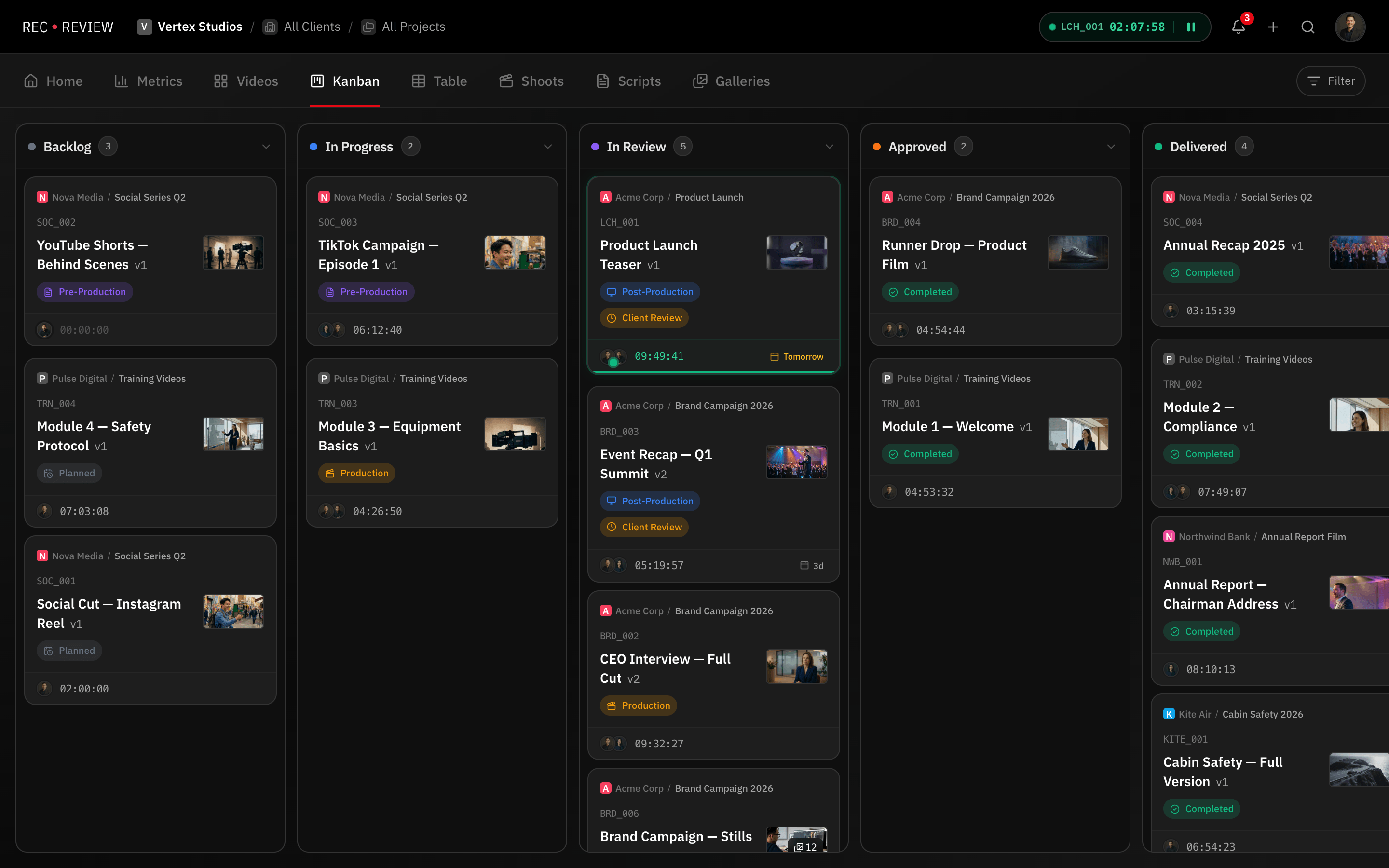
From backlog to done, visually.

Kanban boards, custom statuses, lifecycle phases, subtasks, and due dates for every video in your pipeline. See the full picture at a glance.

Task Management

How it works

Create a task

Each video gets a task with a short ID, assignee, and due date.

Move through statuses

Drag cards across custom kanban columns as work progresses.

Track phases

Lifecycle phases (pre, production, post) give a higher-level view.

Break into subtasks

Checklists inside each task keep editors and producers aligned.

Capabilities

Kanban Boards

Custom columns per workspace with drag-and-drop.

Subtasks

Break work into checklists with assignees.

Phases

Pre-production, production, post-production lifecycle.

Blockers

Flag who or what is holding up progress.

Smart Deadlines

Internal + client dates; the internal clock pauses while you wait on the client.

Global Search

Cmd+K finds tasks, people — even words spoken in your videos.

Kanban Board With Custom Statuses

Organize your work visually with a kanban board where each column represents a custom status. Define statuses that match your actual workflow: Backlog, In Progress, Internal Review, Client Review, Revisions, Approved, Delivered. Every workspace can have its own status definitions.

Drag tasks between columns to update their status, or let workflow automations handle transitions automatically. The board gives producers an instant overview of where every project stands, which tasks are blocked, and what needs attention.

Filter the board by project, assignee, phase, or priority to focus on exactly the work that matters. For studios managing dozens of concurrent projects, these filters turn an overwhelming board into a manageable view.

Phases and Lifecycle Tracking

Video projects move through distinct phases: Pre-Production, Production, Post-Production, Review, and Delivery. RecReview models these phases explicitly, giving you a higher-level view of project progression beyond individual task statuses.

Phases and statuses work together. A task can be "In Progress" within the "Post-Production" phase, then move to "Client Review" within the "Review" phase. This two-dimensional tracking captures the full picture of where a project stands in its lifecycle.

Phase transitions can trigger automations: entering the Review phase can automatically create review subtasks, notify the client, or set a blocker to prevent premature delivery. This ensures your process is followed consistently across every project. Team collaboration features keep everyone aligned throughout each phase.

Subtasks and Checklists

Break complex video tasks into subtasks that can be assigned independently and tracked to completion. A single video might require separate subtasks for color grading, sound mix, captions, thumbnail creation, and final export. Each subtask has its own assignee and completion status.

Subtask completion can drive automations. When all subtasks for a revision round are marked complete, the parent task can automatically advance to the next status. This creates structured workflows that enforce completeness without manual oversight.

Deadlines That Survive Client Delays

Every task carries two dates: an internal deadline for your team and the final date promised to the client. When the client sits on a review, the SLA clock pauses — a client-review blocker freezes your internal deadline until the feedback arrives, so five days of client silence never show up as five days of your team being "late."

The date promised to the client, by design, never moves on its own. What you committed to is what the client sees; what shifts is your internal margin, and the dashboard surfaces deadline risk before it becomes a missed delivery. Deadline pauses can be driven by automations: adding a client-review blocker pauses the clock, removing it resumes — no manual bookkeeping.

Short IDs, Quick Navigation, and Global Search

Every task gets a short, human-readable ID for quick reference in conversations, emails, and chat. Instead of sharing long URLs, your team can say "check ABC_001" and everyone knows which task is being discussed. Video codes are auto-generated to keep naming consistent across the workspace.

Global search (Cmd+K) finds anything in the workspace in a keystroke: tasks, clients, contacts, projects, production plans, team members — and even words spoken inside your videos, because transcripts are searchable too. "That video where the CEO mentions the launch" is a search, not an archaeology project. Pair this with time tracking to understand exactly how long each task takes.

Frequently asked questions

Can I customize the kanban columns?

Yes. Workspace admins can create, rename, reorder, and delete statuses to match your specific workflow. There is no fixed set of columns. Your board reflects how your team actually works.

How do phases differ from statuses?

Statuses represent where a task is in your current workflow, like columns on a kanban board. Phases represent the broader lifecycle stage of the project, like Pre-Production or Post-Production. A task has both a status and a phase, giving you two levels of tracking.

Can I manage multiple projects in one workspace?

Yes. Workspaces support multiple projects, each with their own tasks, videos, and team assignments. The kanban board can be filtered by project so you can focus on one project at a time or see everything across your workspace.

What happens to deadlines while I wait on the client?

Tasks carry an internal deadline and a client-facing one. While a client-review blocker is active, the internal clock pauses and the paused time is compensated automatically — your team's deadline shifts, but the date promised to the client never moves by itself.

Does RecReview replace tools like ClickUp or Asana?

For video production workflows, yes. RecReview combines project management with video review, version control, and delivery in a single platform. This eliminates the need to maintain separate project management and review tools that do not talk to each other.

Ready to try it yourself?

15-day free trial. No credit card required.